
Buyers touring new construction now expect more than granite counters and open floor plans. They expect smart home features new construction homes are increasingly built with. Builders who deliver smart home packages close faster and command higher per-square-foot pricing than those who don’t. On a typical spec home, that premium can run 3% to 5% above comparable non-smart properties, often for far less than the value it adds.
For builders working in Fairfield County, Connecticut and Westchester County, New York, that gap matters even more. Buyers here already expect a high level of finish. A bare-walls, builder-grade home stands out for the wrong reasons next to one that’s move-in ready with technology built in.
This article breaks down which smart home features new construction buyers ask for most, why the fastest-growing categories matter for builders right now, and how to build these in without adding time to your schedule.
What Buyers Notice First
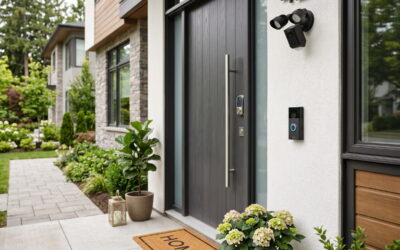
Security is usually the first thing buyers ask about. A functioning camera system, a video doorbell, and smart locks signal that a home has been thought through, not just built. Lighting and shade control comes next. Scheduled scenes and motorized shades photograph well and feel high-end during a walkthrough.
Climate is the quiet third. Zoned, app-controlled climate control doesn’t show up in listing photos, but buyers notice it fast once they move in. It’s one of the more common reasons for callbacks when it’s missing.
The Categories Growing Fastest
Lighting and shading are leading the growth curve. Industry data from CEDIA projects this category to grow by roughly 34%, which tracks with what buyers are asking for on walkthroughs. Builders who get ahead of that shift now will have an easier time matching buyer expectations over the next few years, not just this one.
Why This Matters More in Fairfield County & Westchester
Homes in this market range from roughly $500,000 to well over $10 million. At every price point, buyers expect the technology to match the finish level. A $2 million colonial with no lighting control or camera system feels unfinished, even with a perfect kitchen.
Builders and architects working in towns like Greenwich, Darien, New Canaan, Westport, and Ridgefield in Connecticut, and Rye, Scarsdale, Armonk, and Bedford in New York, are increasingly building this in from the start rather than leaving it to buyers to add later.
How Expectations Shift by Price Point
At the $500,000 to $1 million range, buyers usually expect the basics done well: a video doorbell, a smart thermostat, and reliable WiFi throughout the home. They may not ask for a full system, but they notice if the network can’t handle a family’s devices.
Above $1.5 million, expectations climb fast. Buyers at this level have often seen full automation in other homes they’ve toured. They expect lighting scenes, zoned climate, and a security system that works from one app, not four.
Above $3 million, smart home features new construction buyers expect become closer to a checklist item than a bonus. Whole-house audio, a dedicated home theater, and landscape lighting often come up during the very first walkthrough.
Building These In Without Slowing Down Construction
The features buyers want don’t have to add time to a build schedule. Planned early, structured wiring and a network closet go in during framing, alongside electrical and plumbing rough-in. Done this way, it adds days, not weeks, and avoids the change orders that come from adding technology after drywall.
What This Means for Builders in Connecticut and New York
Smart home builders in Connecticut and New York are competing for the same buyers, often on the same street. The builder who can point to a working camera system, connected lighting, and a single-app experience during a showing has a real edge. We work directly with builders and architects across both states to plan this in from the design phase, so it’s ready on closing day, not months later.
You can see how this has played out on past projects in our portfolio, and review our current brand and platform options before your next spec home or custom build.
The bottom line: the smart home features new construction buyers expect keep expanding every year. Builders who plan for them from day one, rather than reacting to buyer requests mid-build, are the ones capturing the premium. That’s true whether the project is a single spec home or a multi-lot development.
Planning a new build in Connecticut or New York? Talk to our builder team about adding smart home features from the ground up.
Frequently Asked Questions
What smart home features do new construction buyers expect most?
Security and cameras top the list, followed closely by lighting and shade control. Zoned climate control matters less in photos but shows up quickly in buyer satisfaction after move-in.
Do smart home features really add resale value to new construction?
Yes. Pre-wired, connected homes commonly sell for 3% to 5% more than comparable homes without these features, and they tend to spend fewer days on market.
Does adding smart home features slow down a build?
Not if it’s planned early. Wiring and network infrastructure installed during framing adds very little time. It’s retrofitting after drywall that causes delays.
Do builders in Connecticut and New York need a smart home partner for every project?
Not every project needs full automation, but having a builder partner on call makes it easy to scale up or down based on what each buyer wants.